Product
Condition, rarity, material, size, photography, postage, and selling duration influence perceived value.


Systems Thinking · Research Visualization · Academic Project
A visual investigation of eBay as a second-hand marketplace system. Five complementary models expose how products, buyers, sellers, prices, response time, trust, and platform safeguards influence one another.
Five models · One marketplace
Each diagram is designed for a specific audience and question, turning an abstract marketplace into relationships people can inspect and act on.
PRICE · RESPONSE · TRUST · PROTECTION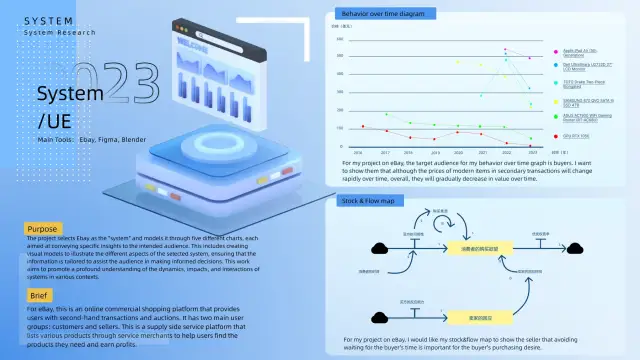
01 · System Frame
The system supports second-hand sales and auctions by connecting two primary groups: buyers and sellers. The research focuses on the elements that make a transaction possible, then expands outward to transportation, platform employees, product information, and protection mechanisms.
Instead of treating eBay as a linear shopping funnel, the project models it as a set of feedback relationships whose effects change over time.
Condition, rarity, material, size, photography, postage, and selling duration influence perceived value.
Budget, trust, available time, information needs, and purchase intent shape the decision.
Reliability, response speed, listing completeness, and pricing choices affect conversion.
Support, accountability, and loss recovery reinforce user rights and marketplace confidence.
02 · Change Over Time
The behavior-over-time diagram compares products from electronics to furniture and makes one pattern legible: resale prices fluctuate, but modern items generally lose value as time passes. For buyers, this supports more informed expectations about timing and depreciation.
The stock-and-flow model shifts the audience to sellers. It shows purchase desire as a stock influenced by buyer availability, priority competition, consumer time, seller response, and the buyer's ability to respond.
03 · Relationship Models
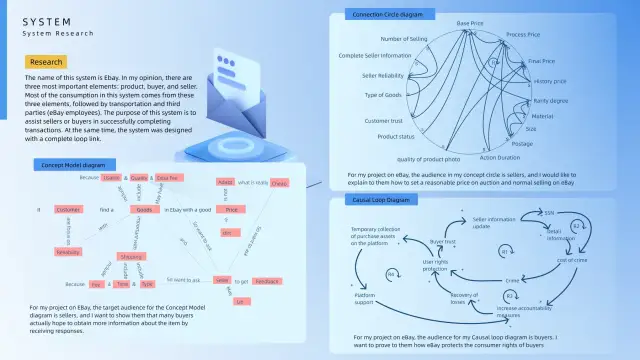
Connects goods, price, reliability, shipping, seller feedback, quality, and usability.
Shows how base price, process price, product status, seller trust, rarity, and logistics interact.
Maps how trust, rights, crime, accountability, recovery, and platform support reinforce one another.
Every diagram changes emphasis according to whether the reader is a buyer or a seller.
04 · Research Outcome
For buyers
The models explain depreciation and show why complete information and platform safeguards matter.
For sellers
Response time, listing quality, reliability, and price construction become visible levers.
For the platform
Support and accountability are not isolated features; they participate in a reinforcing trust loop.
For the designer
Changing the model changes the question, audience, and level of detail without changing the underlying system.
Five visual lenses for understanding how a marketplace behaves.